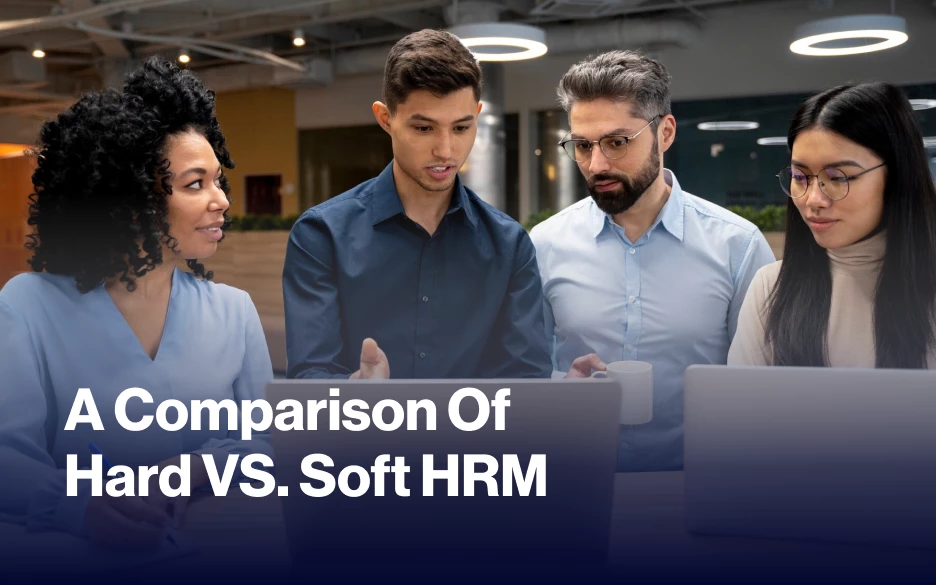

Human Resource Management (HRM) shapes workplace culture and practices through various methods. Managing people involves adopting either a hard or soft HRM approach.
But what’s the impact of Hard VS. Soft HRM on your organisation? Each method operates under distinct rules, managed by HR managers and upheld by employees. Understanding their workings and nuances is crucial to grasp their effects.
What Is Hard HRM?
Hard HRM represents the conventional approach to Human Resource Management, characterised by a focus on strategic outcomes. It’s almost like treating the workforce as the gears in a machine, all aimed at maximising business performance.
As a result, individuals here are seen as tools for accomplishing tasks, committed to regulations and performance metrics, and maximising productivity while minimising costs. The focus is less on employee satisfaction and more on meeting business goals above all else.
But here is the catch: when people feel like they’re just a part of the system, it can lead to disengagement. When an organisation treats its employees as mere resources, employees also treat the company as something that pays wages for hours, lacking job satisfaction and a sense of ownership in projects that require passion.
Read More: The Difference Between HRIS And HRM?
Characteristics Of Hard HRM
Clear Expectations
Hard HRM sets clear rules and guidelines, ensuring that team members know exactly what is expected of them. This clarity helps everyone understand their roles and responsibilities in the workplace.
Increased Efficiency
Hard HRM promotes efficiency by focusing on getting the most work done with the least resources. Basically, it is the equivalent of having an organised schedule that streamlines tasks for maximum efficiency.
Smart Decision-Making
Managers using Hard HRM rely on concrete data and numbers to make decisions. Through data-driven decision-making, the company can make informed decisions that ultimately contribute to its success.
Control And Order
Hard HRM maintains control and order within the organisation. It’s akin to a traffic signal regulating the flow of activities, ensuring that everything runs smoothly and according to plan.
Cost Savings
Treating employees as a resource to be optimised helps the company save money. Every dollar spent on employees is carefully managed to ensure maximum efficiency and cost-effectiveness.
Performance Recognition
Hard HRM acknowledges and rewards employees who perform well. It creates a system of recognition that encourages high standards.
Achieving Targets
Hard HRM is goal-oriented, aiming to hit specific targets and objectives. This approach ensures that the company’s efforts are directed towards achieving predetermined goals, contributing to overall success.
What Is Soft HRM?
Soft HRM, sometimes also known as a progressive form of Strategic Human Resource Management (SHRM), takes a more compassionate approach to both employees and organisational goals. Unlike its counterpart, hard HRM, it does not see personnel as a means to gain only; it gives back to people to create a positive work environment.
In the soft HRM model, human resource managers see their employees as valuable assets and emphasise their development, well-being, and communication. Many small businesses approach soft HRM to ensure their employees stay motivated.
Soft HRM believes in investing in employees for long-term success. It is a more people-centric approach that acknowledges healthy employer-employee relationships. HR managers in soft HRM prioritise communication and employee engagement. Because of this, staff members adore and remain motivated by soft HRM techniques.
Characteristics Of Soft HRM
Happiness At Work
With Soft HRM, it’s like working in a place where people’s welfare matters. This approach holds that work should not just be about tasks; it should be about feeling that they have a purpose and are serving it as they do it.
Work-Life Balance
Soft HRM practice is all about flexibility. It’s like having a job that understands life happens; whether it’s family commitments or personal needs, there’s room for balance.
Growing Together
Being part of a family that values individual growth. It’s not just a job; it’s a journey of developing skills and becoming the best version of oneself while helping the employer reach the heights of success.
Open Communication
Soft HRM provides more breathing space, and people are less restricted in their expression. Communication is open, and everyone’s voice matters, more like brainstorming together as a team to reach success than just following rigid protocols.
Investment In Individual
Soft HRM recognises employees as investments rather than mere resources. It’s akin to having someone believe in an individual’s potential and actively support their growth, much like a mentor guiding a career path.
A Supportive Culture
Imagine being in a workplace where support is not just a concept; it’s ingrained in the culture. Soft HRM creates an environment where everyone has support when they need it and knows they have access to resources in need.
Job Satisfaction
The best thing the soft HRM approach drives is job satisfaction among people. It prioritises building lasting relationships, self-improvement, and growth in the workplace. With this, community bonding is fostered where loyalty and commitment are valued.
How Does It Differ? Hard VS. Soft HRM
Here’s a comparison between Hard VS. Soft HRM at a glance:
| Aspect | Hard HRM | Soft HRM |
| Approach to Employees | Sees employees as resources or tools to achieve business objectives. | Views employees as valuable assets, emphasising their well-being and development while achieving organisational goals. |
| Guidance and Rules | Relies on clear rules and structures for guidance. | Offers more flexibility in work arrangements. |
| Decision-Making Style | Makes decisions based on data and metrics. | Considers personal and individual growth in decision-making. |
| Communication Style | Often involves top-down communication and centralised decision-making. | Emphasises open communication and employee participation in decisions. |
| Cost Perspective | Aims to optimise costs and sees employees as a cost to be managed. | Views employees as an investment, prioritising their development. |
| Recognition and Rewards | Recognises and rewards performance with a focus on quantifiable results. | Emphasises job satisfaction and fulfilment as a form of recognition. |
| Goal Orientation | Goal-oriented, focusing on achieving specific targets. | Prioritises work-life balance and personal well-being. |
| Employee Relationships | Treats employees as resources to be used efficiently. | Emphasises building positive and supportive relationships by empowering employees. |
The Bottom Line
Hard VS. Soft HRM may seem like opposite ends of the spectrum, but both have their perks for a company. The key? Finding the sweet spot that aligns with the company’s ethos and objectives.
The magic lies in blending structured methods with people-centric approaches. It’s like crafting the perfect concoction for a resilient and vibrant workforce. This holistic approach, valuing both efficiency and the human element, lays the foundation for cultivating a robust and enduring workforce.